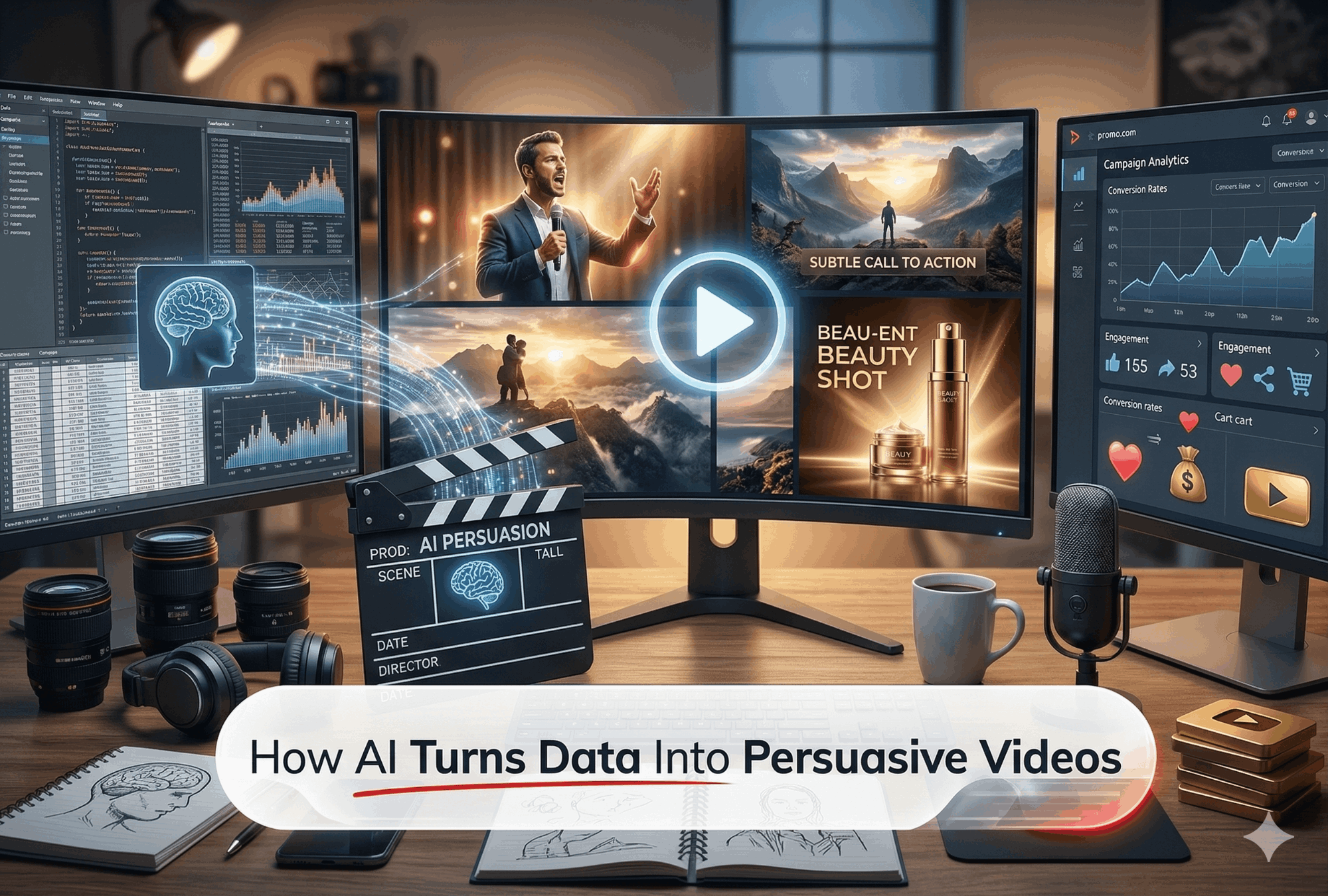
How AI Turns Data Into Persuasive Videos

The difference between content creation strategies in their inception and today is night and day.
One major indicator of this immense variance is the exodus from manual video production to the more sophisticated data-driven creative projects. If this is a bit too intense for digestion, you only need to look at the volume of information that modern creators and brands now depend on for their creative approach.
Back in the day, a marketing video used to be a product of the best guesses at the brainstorming roundtable or something out of the creative director’s vast imagination. It is a different ball game these days.
Nowadays, raw data indicators oversee every frame. Thus, when you deploy an AI marketing video generator, it compiles a visual argument based on various crucial factors. This piece of technology creates a masterpiece by considering historical performance, target demographics, and real-time engagement analytics.
Transitioning to automated marketing video creation allows creators to achieve a degree of precision that was practically impossible before now. The data from multiple critical sources dictate the play; every color choice, the cut speed, and the timing of a call-to-action (CTA).
Whatever these metrics suggest will get the number of clicks a video requires for success essentially becomes the main focus. In this article, we explore the technical aspects of raw data’s influence in modern content creation, including how to ingest and transform it into video assets that convert at incredible rates.
The Data Loading or Assimilation Phase

The process begins with data assimilation. Before rendering the slightest pixel with an AI marketing video creator, you must load the specific datasets into the software. The primary sets of data necessary for the required results usually include:
- Customer Purchase History: What products do the customer typically buy together?
- Search Intent: Are there any particular terms that might be leading people to the landing page?
- Demographic Heatmaps: What is the location of the most active users, and what is the dominant age range?
Upon recognizing this dataset, the AI marketing video software uses it to select an approach for a video. For example, if the data shows that users in their late twenties are the primary buyers of a specific skincare product, the AI marketing video generator will focus on applying fast-paced editing with bright, vibrant hues. Here, the data serves as the recipe, and the video is the pastry.
How Does AI Turn Data Into Persuasive Videos?
1. Synchronizing the Core Content Variables
When a brand uses an AI marketing content generator, the tool goes over thousands of customer reviews and social media comments to identify the most prominent customer pain points. This is what brands call sentiment mapping.
If the data shows that the complexity of the competitor’s product is too intense for customers, the AI marketing video creator will adjust the script to emphasize simplicity. It also synchronizes the voiceover and text overlays with the deductions from the data.
With this approach, the AI product marketing video actively answers the viewer’s burning questions and does not just display the product. At the end of the video, the viewer should feel as though the brand is directly addressing their needs.
2. Color Grading with Statistical Backing
Data dictates how a video would look in ways that humans might not consider. An AI brand video generator analyzes which colors have historically led to the highest retention rates for a specific industry.
For example, the financial sector data might suggest that deep blues and greys give off a sense of reliability and stability. So, if a fintech app launch requires a video made with the AI video marketing tool, it automatically applies this information to the color schemes of every shot. With this rather statistical choice, the video goes through grading that evokes a unique emotional response, and the data identifies as best for conversion.
3. Using the Best Narrative Based on Regional Trends
Many global campaigns fail because they use a generic approach for all regions. With automated marketing video creation, brands can now produce multiple versions of the same video for different markets.
For example, an AI social media marketing video might use footage of a city street in New York for an American audience. Meanwhile, using an AI personalized marketing videos engine for the same campaign, it swaps that footage for a London street when someone in the UK watches it.
The data also suggest exactly which lifestyle imagery will feel genuine and native to the viewer. As this software removes the foreign barrier that often causes viewers to disengage, its localization boosts the video’s persuasive potential.
4. Data Analysis for Retention and Correct Pacing
The video’s speed and vibe are perhaps the most critical technical functions. An AI video marketing tool analyzes parts of a video where the viewer loses interest the most and sometimes scrolls away from previous campaigns. If the data indicates that 50% of viewers exit a video just ten seconds in, the AI marketing video generator identifies what was happening at that exact moment.
By the time the software creates the next version of the video, it will make adjustments at that 10-second mark to ensure viewer engagement. This type of pacing will wrestle with the viewer’s urge to exit the video.
5. Low-Budget A/B Testing at Scale
A/B testing for two separate videos is expensive and time-consuming, especially in conventional production. However, an AI video ad generator can produce dozens of variations of a single ad in just a few minutes.
These variations are then distributed via an AI video advertising platform. The live data from these ads is reinjected into the AI marketing video creator for testing. The versions that underperform are automatically removed, while the promising ones with high engagement potential get a bigger budget. The data will continually refine the video until only the most compelling variation remains.
6. Personalizing Video Content with Critical Consumer Data
Injecting information specific to individual users into the video is perhaps the most advanced use of an AI personalized marketing videos platform. You will often see this on review or highlights videos, and sometimes personalized offers.
In this approach, the AI marketing video software takes data from the user’s own account, such as their name, most purchased item, or how long they have been a customer. It then renders it in the form of a text overlay or a custom voiceover. This instantly turns a generic AI promotional video maker asset into a piece of content that looks custom-made by a human editor. The persuasive pull of seeing one’s own name or history in a top-quality video is significantly higher than any generic advertisement.
7. Campaign Creation Based on Consumer Habits
Videos that are made on the back of heavy reliance on consumer data are about when they air as much as what they contain. Through AI marketing automation video, individual users’ online shopping habits often prompt the creation of the content.
If a potential customer abandons their shopping activity on an e-commerce website, the data signals an AI marketing video creator to generate a 15-second reminder video. This video might feature the exact items left in the cart, along with an enticing discount code. It also ensures that the brand remains at the top of the user’s mind exactly when they are still considering buying. With the global cart abandonment rate exceeding 70%, the video might be the last attempt at encouraging the customer to revisit and complete their order.
The Production Process From Data Point to Export
To understand the internal workings of an AI marketing video generator, one must look at the assemblage of the software package. This process occurs in four main stages, all in a matter of seconds
1. Data Parsing
The AI marketing video creator collects the CSV files, API feeds, or pixel data. Then, the parser function identifies the key elements, such as audience profile, conversion or awareness goals, and platform type.
2. The Logic Engine
The software consults its collection or library that contains data on millions of previous videos. It operates similarly to a human user by asking questions like, “What is the best opening shot for an 18-year-old female on TikTok interested in fashion?” The logic engine then decides on the appropriate artistic direction.
3. Asset Assembly
The AI promotional video maker selects from a collection of “B-roll,” background music, and text fonts. If the data favors urgency, it opts for a fast-tempo track and bold, red typography. If the metrics suggest luxury, it applies slow-motion footage and gold-toned color grading.
4. Video Rendering and Optimization
The AI video ad generator is capable of rendering the final file. At this point, it also optimizes the file for the specific platform. For example, if it is an AI social media marketing video, it places the text in the areas where it is crucial video elements, such as the “Like” buttons or the user’s profile icon, won’t cover it.
Solving the Creative Fatigue Problem
The digital marketing industry has had its fair share of struggles, and creative fatigue looks to be one of the most challenging ones for creators and audiences. Creative fatigue occurs when an audience stops viewing an ad because they have seen it too many times already. Fortunately, an AI marketing content generator solves this problem by constantly revisiting the translation from data to video content.
The problem is simply tasteless repetition. Soon, even the most positive and patient viewer will become disillusioned with seeing the same ad every time. So, instead of showing the same video for a whole month, the AI marketing video creator can generate a slightly different version periodically. Recreating a slightly different version every three days based on the latest performance metrics can significantly change the whole landscape.
Also, the AI makes further adjustments according to newer sets of information. For instance, if the “Click-Through Rate” (CTR) starts to dip, the AI brand video generator automatically changes the background score or intro clip. This makes sure that the ad always looks fresh when the algorithm and the viewer see it.
Why Video Advertising Platforms Are Moving to AI?
The need to release quality content as quickly as possible influenced the migration toward an AI video advertising platform. To illustrate, a trend can begin and end all within the space of 48 hours in the current market.
In reality, it is almost impossible for a production or creative team of humans to conceptualize, write, film, and edit a video in that period. Even if luck permits them to achieve this feat, it is impossible to rely on luck to do this consistently.
However, an AI marketing video creator can ingest the data from a viral hashtag and create an AI promotional video maker asset that is ready to post in ten minutes. This gives brands the exclusive advantage of being part of the conversation while it is still relevant.
It is a symbiotic relationship. While the data provides the context for the asset, the AI marketing video generator creates the content.
The Role of AI in Product Marketing Videos
The data for complex products like software or specialized machinery is simply used to make the message clearer and easier to digest. An AI product marketing video uses correct metrics to identify which technical features are the most confusing for customers.
Realizing the need to simplify complex terms, the AI marketing video software then prioritizes explainer segments that address those key areas. By using automated marketing video creation, the brand can produce a series of visual tutorials for the user based on their current level in the onboarding process. This data-driven education is far more helpful than the traditional sales pitch, as it provides value exactly when the user needs it.
Takeaway
The role of the video editor is currently evolving and already different from its conventional function. In a market that highly depends on data, the final cut is not an artistic selection that creators make in a darkened room. Rather, it is the outcome of millions of data pieces that tells a unique story.
When a brand uses an AI marketing video generator, they go from just making a video to creating a living, breathing asset that reacts to the market live. From the initial assimilation of consumer data to the publishing of AI personalized marketing videos, the process goes through constant treatment.
The accuracy in predicting consumer behavior is the main source of the persuasive force of these videos. Rather than trying to appeal to everyone, they aim to convince one person with a single message at a specific time. This is the future of video content marketing, where the data writes the script, directs the plot, and edits the clips all at once. Adopting an AI marketing video creator implies that every second of video a brand produces is an investment in a proven, data-backed outcome.


