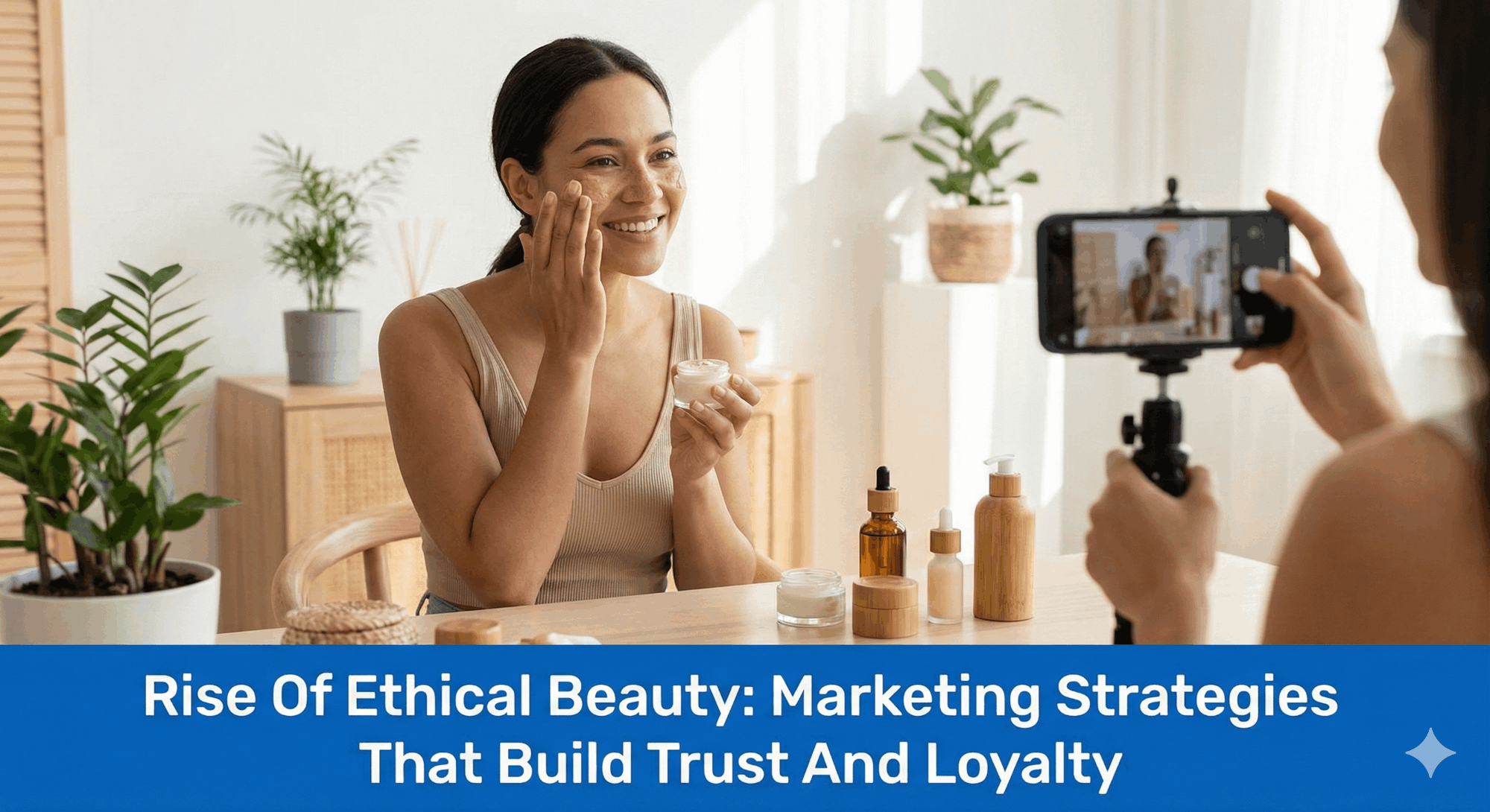
Rise Of Ethical Beauty: Marketing Strategies That Build Trust And Loyalty

Trust is no longer built by what beauty brands promise, but by what they consistently prove.
As consumers become more conscious about ingredients, sourcing, and values, ethical beauty has moved from the margins to the mainstream. Today’s audiences expect transparency, accountability, and alignment between what a brand says and how it operates.
For beauty brands, this shift has changed the role of marketing. Success is no longer driven by aspiration alone, but by credibility. Brands that communicate ethically earn trust. Brands that act consistently earn loyalty.
The strategies below explore how ethical beauty marketing builds trust and long-term loyalty through clear, deliberate, and human-centered approaches — not hype.
Redefine Beauty Marketing Around Transparency, Not Perfection
On the most basic level, beauty marketing begins with a quiet mindset shift: the brand stops striving for flawlessness and starts striving for it to be understood.
The beauty marketing of the past taught the consumer to demand perfection. Airbrush skin, overwrought promises, and inspirational imagery created the promise of the possible without compromise. While very desirable, the problem with this approach is that the consumer is left questioning what is being presented to them due to reality not matching the promise.
By contrast, ethical beauty marketing goes the opposite way. It draws the consumer closer rather than putting the product on a pedestal. It discusses the product’s ingredients clearly. It also puts product formulation processes into perspective. It justifies its product packaging choices, even those that hold some trade-offs.
This transparency alters the behavior of consumers. They go from asking “Is this too good to be true?” to “Does this fit my concerns? This shift is profound. It converts the role of marketing from persuading to partnering.
Transparency does not in any way compromise desirability. Instead, it can actually enhance it. As a consumer can understand the processes that go into the making of a particular item, as well as the reasons for which the item was produced in a certain way, the brand comes across as purposeful rather than performative.
Market Beauty Products Through Education Instead of Hype
Ethical brands have started to revamp the way of marketing beauty products. Instead of relying on hype-based communication, they use education-based communication.
Rather than promoting products as “miracle” solutions, ethical marketing aims to empower a consumer to make an educated decision. This includes understanding what ingredients will do and what can be realistically achieved. Such educational copywriting recognizes consumer intelligence and independence.
For instance, rather than a guarantee of quick results, a truthful campaign could discuss the length of time it actually takes for active ingredients to work, why it’s essential to be consistent, or what results can actually be achieved. Such a degree of honesty will definitely limit impulse buys but will significantly boost customer satisfaction.
Education also leads to less post-purchase regret. If consumers have a clear understanding of what it is that they’re acquiring, there will be less disappointment, and trust will be gained.
Strategically speaking, education-style marketing allows the brand to be perceived as a trustworthy source, not a salesperson. Customers will eventually come back to the brand for the product itself as well as for advice. Customers value advice over misinformation by a considerable margin.

Build Trust by Showing the Reality Behind Beauty Industry Marketing
In the world of ethical beauty industry marketing, transparency is not a luxury but an absolute necessity. People care not only about what brands offer, but also about how they do what they do.
This includes having an open door to processes that were previously opaque. Brands talk about sourcing, meet their manufacturers, and share the development of their formulation. They highlight difficulties instead of hiding them.
Brands that reveal what happens on the other side of their decisions humanize their brand. It becomes less about marketing spectacles and more about substance. It allows viewers a behind-the-scenes look at the work that goes into a given product.
This transparency further leads to accountability. A brand, having opened its doors to consumers, has to be consistent from then on. This consistency leads to greater brand trust.
Authentic and ethical marketing in the world of beauty has a lot to thrive on when it comes to openness. This is because openness eliminates perfection and associates credibility with honesty instead.
Create Loyalty Through Consistent Marketing for the Beauty Industry
Trust may be earned through transparency, while loyalty is built through consistency. In marketing for the beauty industry, consistency signals integrity.
The consumer interacts with a beauty brand at many touchpoints: websites, social media, packaging, customer service, and campaigns. Ethical marketing ensures values remain stable across all these touchpoints.
When messaging aligns over time, audiences feel secure. They know what the brand stands for and what to expect. This predictability is comforting, especially in an industry that’s traditionally associated with exaggerated promises.
On the other hand, inconsistent messaging very quickly erodes trust. A brand cannot advertise sustainability in one campaign and then ignore it in another without raising doubts. Ethical brands internalize that every interaction reinforces or undermines credibility.
Consistency transforms ethical positioning from a marketing angle into a lived experience.
Use Beauty Digital Marketing to Build Dialogue, Not Distance
Ethical beauty digital marketing understands that building trust means having a conversation, not control.
Digital media empowerment has encouraged consumers to ask a question publicly, share experiences, and call claims to account. Honest brands are active in these conditions. They respond to messages, deal with complaints, and modify messages in line with real-world feedback.
This makes the transition from broadcasting to relationship-building. Customers feel heard, rather than controlled. Even complaints become a platform for promoting the virtue of transparency.
Brands that connect authentically online often find themselves with a greater level of loyalty due to being treated with respect. Digital marketing transforms from a reputation management technique to a means for building trust.
Use Beauty Video to Make Ethics Visible
Ethical principles are far more powerful when demonstrated rather than declared. And this is where the role of the video in beauty becomes so important.
There are opportunities to demonstrate processes, introduce the people behind the products, and depict how the products are used. This helps to reduce abstraction. The consumer no longer has to guess what “good formulation” means; they can see it in action.
This exposure creates familiarity. Familiarity creates trust. And this is where the role of the video in beauty becomes so important. Ethical videos in the beauty industry often prioritize information over aesthetics. They look real, informative, and authentic.
When the video is used to illuminate rather than exaggerate, it becomes one of the most powerful trust-builders available to the beauty industry.
Align Digital Marketing in the Beauty Industry With Real Business Practices
One of the fastest ways to lose trust in the digital marketing beauty industry is misalignment. Consumers today are exceptionally good at spotting gaps between what brands say online and what they actually do offline.
Ethical beauty marketing requires tight alignment between digital messaging and operational reality. Sustainability claims must reflect sourcing practices. Inclusivity messaging must align with hiring, representation, and product ranges. Transparency online must mirror transparency internally.
When digital marketing runs ahead of reality, skepticism sets in quickly. Audiences begin to question not just specific claims, but the brand’s integrity as a whole. Ethical brands avoid this by treating digital marketing as an extension of the business, not a mask for it.
This alignment builds quiet confidence. Consumers sense when a brand is grounded. Over time, that sense of grounding translates into trust that is difficult for competitors to replicate.
Position Marketing Beauty Brands Around Empowerment, Not Insecurity
For decades, beauty marketing relied on highlighting flaws. Ethical marketing beauty strategies intentionally move away from this approach.
Rather than framing products as solutions to inadequacy, ethical brands position them as tools for self-care, expression, and confidence. Messaging focuses on choice rather than correction. Beauty becomes something consumers participate in, not something they must fix.
This shift fundamentally changes the emotional contract between brand and audience. Consumers no longer feel pressured to conform. They feel supported in making decisions that align with their values and preferences.
Empowerment-based marketing builds loyalty because it removes manipulation from the relationship. Customers return because they feel respected, not because they feel dependent. That distinction matters deeply in an industry built on identity and self-image.
Use Website Design to Reinforce Ethical Credibility
Building trust relies on actions, not just putting the right words down. And so, beauty website templates serve as an ally to website layout and should, therefore, be treated as more than an aesthetic choice.
An ethical beauty website ensures that all relevant information about the product is available. Each product page makes it clear what is included in the product, where it is made and sourced, and how it should be used, all presented to the user in simple terms. All navigation is straightforward, not created to encourage impulsive decisions.
A website’s design can reflect a business’s ethical values. A clean design will communicate confidence. An ethical beauty brand has an easy way to access all the additional information available about that product.
Ethical companies never use marketing tactics to manipulate their customers, such as creating artificial scarcity or using overly complex pricing. If a beauty website appears truthful and intuitive to customers, they will spend more time on the site, searching and reading content, thereby contributing to a positive brand image and loyalty.
Build Local Trust Through Ethical Beauty Salon Advertising
For service brands, the first stage of trust often begins with beauty salon ads.
A responsible salon marketing effort aims at professionalism, cleanliness, knowledge, and customer service, rather than makeover transformations. Advertisements include experience, skills, and the product used. Notions are clearly defined, rather than exaggerated.
This is especially the case for a local market. News spreads quickly through personal recommendations. It is hard to win loyal clients when a salon promotes itself through totally up-front advertising.
Ethical advertising in local markets involves relationship-building, not transaction-building. Customers will come back because they feel secure, understood, and appreciated.
Use Beauty Video to Show Process, Not Just Results
In ethics within beauty marketing, a beauty video is most potent when showcasing process over perfection.
Video lets brands show how products are formulated, treatments delivered, and the personalities behind the brand. Such visibility reduces abstraction and builds familiarity; consumers see the care, effort, and intention rather than outcomes alone.
Ethical beauty videos tend to feel slower, more grounded. There is a sense of explanation over spectacle. Real people replace idealized imagery. The result is content that feels credible rather than aspirational.
When audiences understand how something is made or delivered, trust forms naturally. Video becomes a bridge between brand values and consumer confidence.
Partner With a Cosmetic Marketing Agency That Understands Ethics
The involvement of a cosmetic marketing agency can either fortify or undermine the ethical foundations based on alignment.
Credibility is not something that can be built. It is either there or it isn’t. This means what brands need is what ethical agencies do. They help brands articulate values accurately, audit claims carefully, and ensure consistency across platforms.
Such collaboration is beneficial in this new era of increasing attention. An agency with an understanding of what constitutes the line between truth and exaggeration helps brands stay on the positive side of it.
As strategic business partners rather than hype generators, these agencies help promote trust rather than undermine it.
Measure Success Through Loyalty, Not Just Visibility
Ethical beauty advertising calls for new standards to evaluate success. Instead of concentrating on mere impression or awareness metrics, ethical approaches consider retention, repeat business, advocacy, and engagement value. The key would finally lie in loyalty.
A long-run perspective brings marketing into harmony with branding. Trust grows slowly, but its power is long-lasting. Those brands that measure the numbers behind consumer loyalty recognize that the kind of growth that comes from trust is less susceptible to the challenges of the business cycle than the kind of growth that comes from innovation.
Ethical marketing encourages waiting. The results are richer, although they come later.
Treat Ethical Beauty Marketing as an Ongoing Commitment
Ethics should not be seasonal or campaign-based.
Brands that know how to win understand that ethical marketing is a constant practice in improvement. Every product launch, every piece of content, and every customer interaction reinforces or weakens trust.
Credibility is built over time through consistency. Accountability turbocharges it. Ethical brands will also acknowledge their mistakes and publicly make improvements, rather than trying to conceal missteps.
It is this continued action that makes ethical positioning true loyalty, not superficial praise.
Why Ethical Beauty Marketing Creates Brands People Stay With
Ethical beauty marketing works because it finally aligns business goals with human values.
Where choice is everywhere, trust is the decider. Brands that communicate transparently, act consistently, and respect their audience are rewarded with loyalty beyond trends.
Consumers will remain loyal to brands they can trust, especially those that demonstrate transparency and responsibility. Moreover, watchdog groups continue to beat the drum for clarity and consumer education in the personal care space.
Ethical beauty marketing is not about perfection. It is about honesty, accountability, and alignment. Brands that embrace these principles do more than sell products. They build relationships.
And in beauty, relationships are what last.


