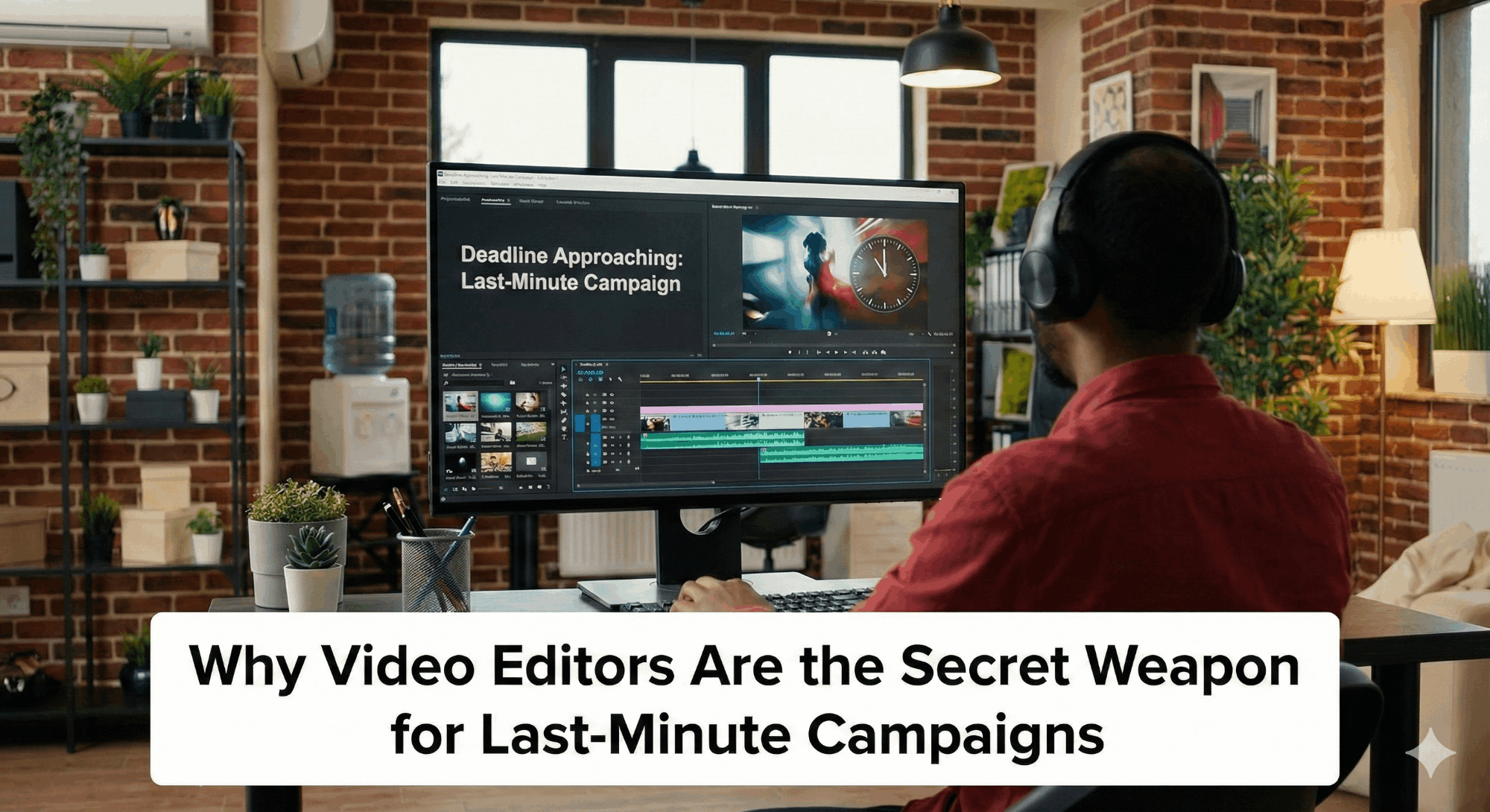
Why Video Editors Are the Secret Weapon for Last-Minute Campaigns

Every marketer loves the idea of “moving fast” until speed becomes non-negotiable.
There’s a particular kind of pressure that only shows up when timelines collapse. A campaign that was never planned matters suddenly. A product update needs visibility now. A trend peaks before the weekly meeting even ends. The task is blunt and brutal: launch something immediately, without making it look rushed.
At that moment, marketing isn’t theoretical anymore. Strategy decks are of little help. Brand guidelines don’t automatically build themselves. What matters is whether your team can actually do high-quality content under extremely high time pressure.
Video is the most potent medium in modern marketing, yet it’s usually the first casualty of urgency. It’s too slow, too complex, too reliant on specialists. So teams default to static posts, rushed copy, or silence.
And yet some brands do the opposite. They lead with video. They dominate attention during the last-minute moments. They look prepared, while everyone else looks reactive.
Their advantage isn’t creativity. It’s tooling.
Specifically, it’s how they use modern video editors — particularly AI-powered ones — as execution infrastructure rather than creative luxuries.
The AI Video Editor as Execution Infrastructure, Not a Creative Tool
The biggest mistake teams should avoid when considering video editors is assuming they are creative software. That approach instantly sets boundaries on their worth.
For last-minute campaigns, it is not about making videos attractive. It is about being able to act on decisions.
“Urgency” underscores that all teams recognize that “ideas are cheap, but execution is where the scarcity is.” When urgency is introduced, the shortage isn’t in the brainstorming stage but in executing on those plans. This is the role of the AI video editor as execution eliminators.
First, it collapses production time. What once required dedicated human effort—trimming videos, syncing audio, resizing for different delivery formats, adding captions, and inserting transitions—is now handled by the application. This alone qualifies videos as going from “high effort” to “low friction.”
The bigger impact is organizational, though. When video-making is fast and scalable, it becomes decentralized as well. Campaign managers and growth marketers don’t have to wait for “The Video Person” anymore. When video is easy to make and widely available, it can be created by everyone, even founders and social media leads.
This decentralization is critical in last-minute scenarios. Urgency punishes dependency. Every extra handoff adds delay. AI video editors quietly remove entire layers of dependency from the process.
The result is not just faster videos — it’s more rapid decisions. Teams stop asking whether video is feasible and start asking how quickly they can deploy it.
Why Urgency Changes What “Good” Marketing Looks Like
When there is urgency, it not only makes things happen faster, but it also shifts what is considered an acceptable level of results.
Under normal circumstances, one would seek to create polish and storytelling cohesion over time. In urgent situations, one needs to appeal to an entirely different value: relevance.
A “now” video can easily trump a “perfect” video. When consumers feel as if a brand is communicating in real time, they respond in different ways. They respond to a sense of shared context.
This is what is making AI video creation tools the core of marketing, not a peripheral anymore. These tools enable the brand to operate in the moment, rather than comment on it after the fact.
Urgency also affects the tolerance for hesitation. If the timeline is short, teamwork either completes the task or misses it. Video editors make the task easier, and if it is easy, people do not hesitate to act.
Speed has a ripple effect, impacting production but also confidence.

How Fast Video Makers Reshape Campaign Planning Itself
A fast video maker is not only time-saving but also transforms the concept of campaigns from the outset.
The traditional approach to video production demanded certainty. Since video production was time-consuming and costly, clarity was needed before moving ahead.
The scripts were finalized. The message was locked. The stakeholders were aligned. Therefore, video production couldn’t be spontaneous.
Fast video makers turn this idea on its head. As it is easy to produce videos now, teams won’t need clarity. They can evaluate their ideas through implementation. The messaging will change as the assets change. The campaign will become flexible, not rigid.
This is particularly crucial for last-minute marketing campaigns. More often, the insight that triggers the marketing campaign is incomplete. The market is always dynamic, and the insights are yet to come. With fast video creation, marketers can always react despite the incomplete insights.
Rather than putting off until the point of certainty (and even when it arrives, it’s rare), they get started and iterate in public. This ability to act on incomplete information is what gives it a competitive advantage.
AI Video Editors Online and the Elimination of Hidden Delays
The AI video editor online tackles one of the most underrated enemies of emergency campaigns: the drag factor.
Many groups, in theory, can move fast. They don’t, in practice, because they have logistical inefficiencies. Files have to be transported from place to place. Programs have to be opened on the correct computer. There’s confusion about versions. Comments are late.
The time differences are eliminated when using cloud editors. As everyone is working in the same space, teamwork becomes instantaneous. People can view a draft as soon as it’s made. Edits are shown in live mode. No need to wait for exports/upload.
For instance, under time urgency, those little efficiencies add up quickly. What starts out looking like a small benefit makes all the difference between launching today and not launching at all.
Speed is rarely lost to major obstacles, but it is lost to dozens of small ones.
Quick Video Editing Software and Mental Load Under Pressure
Last-minute campaigns don’t only validate time constraints. They validate individuals.
When urgency hits, cognitive overload accelerates beyond what most teams expect. Decisions cascade. Messaging must sync. Communication channels demand focus. Approvals must occur instantly. Productivity standards remain high despite the shrinking clock. This is where the bottleneck is not a matter of effort or intention. This is a matter of cognitive capacity.
It is here where quick video editing software excels. This is because it eliminates enough of the technical friction that a marketer must make a series of decisions to post something. One doesn’t have to focus on considerations of frame rate, export options, or other formats. These are all taken care of.
Under pressure, poor decisions usually stem from overload, not from a lack of competence. Quick editing tools protect decision quality by lowering cognitive strain. In that sense, speed doesn’t undermine quality. It safeguards it.
Automated Video Production and the Reality of Multi-Channel Urgency
Last-minute campaigning rarely happens alone. The same update might have to appear on social media, newsletter updates, paid ads, landing pages, and possibly company-wide communications, all at about the same time.
The systems used for each of those communications have different requirements, different distribution rhythms, and different design constraints. Managing all of that manually, under time constraints for video distribution, is not only inefficient; it’s also impractical. It is impossible!
Automated video production alters the dynamic, treating variation as a system rather than a task. AI automatically generates different formats, dimensions, and layouts while preserving message consistency.
Instant Video Makers and Cultural Timing
Culture doesn’t wait for marketing calendars.
Trends happen spontaneously, reach a peak out of nowhere, and fade away equally suddenly. Often, by the time several teams notice a “moment” significant enough to respond to, it is already past.
Not only is a potential engagement opportunity missed, but a perception is created that the brand is out of touch. An instant video maker enables participation in the conversation while it is still relevant. This participation is independent of perfection or analysis. It is based on presence. Participating in the conversation as it is happening is indicative of awareness and competence.
Notably, response time is perceived differently from sloppiness. Quick responses can be viewed as authentic rather than careless. Slowly but surely, the perception develops that a business is informed and engaged.
Creating Last-Minute Marketing Videos Without Damaging the Brand
Often, the fear that comes with that urgency is erosion of the brand.
If timelines ever collapse, there’s a fear of slipping standards. The fonts will change. The colors will shift. The logos might get abused.
Modern video editors solve this problem structurally and not procedurally. Brand kits, locked templates, auto typography, and enforced color systems integrate identity into the process itself. Identity is then a feature of the process and not something to be managed on a personal scale by each designer.
This is a paradigm shift. Brand integrity is no longer reliant on people recalling guidelines in high-pressure situations. It is self-enforced, whether it is the brand, the brand assets in question, or the speed of creation.
Teams can then act swiftly without second-guessing every creative decision. Going fast is no longer threatening. The urgency no longer hurts the brand. It only hastens brand visibility.
Social Media Video Campaigns as Living Systems
The social video campaign is not a completed product, but a living system.
The performance data is virtually instantaneous. View-through rates, engagement behaviors, points of halting, or conversions all paint a picture immediately. Those who succeed are not necessarily those who have all their predictions right off the bat, but those who can react first to what the data shows.
Video editors help to achieve this. Hooks can be rewritten. Intros can be shortened. Pacing can be modified. Messaging can be reframed throughout the production process without having to start from scratch.
In last-minute campaigns, such flexibility is sometimes worth more than the original creative idea itself. A mutable strategy is always more successful than an immutable strategy during a running campaign.
Brands that consider their efforts as living systems rather than a complete deliverable add more fuel to their winning cycle.
Video Marketing Automation as a Form of Preparedness
The best marketing operations aren’t dependent on heroics when urgency is at stake. They’re dependent on systems.
Video marketing automation makes preparedness a virtue within the organization itself. The templates are ready for use before they are even needed. There are predefined workflows. Brand guidelines are not to be reviewed; they are to be enforced.
When an unforeseen opportunity presents itself, the execution is not frantic. In fact, it is procedural. The pressure is absorbed in the system. This is where an opportunity arises unexpectedly.
This readiness converts urgency from threat into an opportunity. The teams act swiftly, not because of a rush, but because of their readiness.
Promotional Video Makers Under High-Stakes Constraints
Some campaigns leave no margin for error.
Product launches, limited-time offers, and competitive responses operate under immovable deadlines. Delays don’t just reduce impact. They eliminate it.
A reliable promotional video maker ensures that execution doesn’t become the weak link. These tools integrate visuals, messaging, and calls to action into cohesive assets quickly, reducing ambiguity when time is scarce.
Under pressure, reliability is not a convenience. It’s a competitive advantage. Teams that trust their tools move decisively. Teams that don’t hesitate — and hesitation is costly.
Online Video Editors and Internal Autonomy
Competent online video editing for marketing saves you on resources exactly when you are most vulnerable to being reliant on them.
With the ability to move without waiting for agency, freelancer, or specialist involvement, the team regains control of the timeline. Decisions come faster. Iterations happen immediately. Team confidence goes up because the implementation is in-house.
This is important. When teams feel they can move quickly, they are more inclined to do so. Freedom sparks activity, and activity seizes opportunity.
In urgent contexts, the control of tools equals the control of outcomes.
Template-Based Video Makers and Controlled Speed
Speed without structure produces chaos. A template-based video maker gives the sense of balance needed when urgency knocks. They serve as the creative guardrails, enabling uniformity and versatility in the right places.
Teams can easily exchange messages, images, or offers without recreating assets from scratch. Their identity is maintained despite the swift production rate.
This is what makes the scale able to resist pressure. Without templates, speed is associated with fragmentation. With templates, speed is sustainable.
Brand Video Automation and Consistency at Volume
As output increases, maintaining consistency becomes exponentially more complicated.
Brand video automation embeds standards directly into production, ensuring every asset aligns with the identity, regardless of volume. Errors decrease. Review cycles shorten. Approvals become faster because fewer corrections are needed.
Scale stops threatening quality. Instead, it reinforces it.
Conclusion
Last-minute campaigns are no longer exceptions but have become structural characteristics of marketing.
Video editors, particularly artificial intelligence video editors, have become an execution infrastructure. They enable pacing, ensure quality is maintained, and offer relevance when it is needed most.
With the average attention span being short, video editors have become an essential tool. These are strategic weapons.


