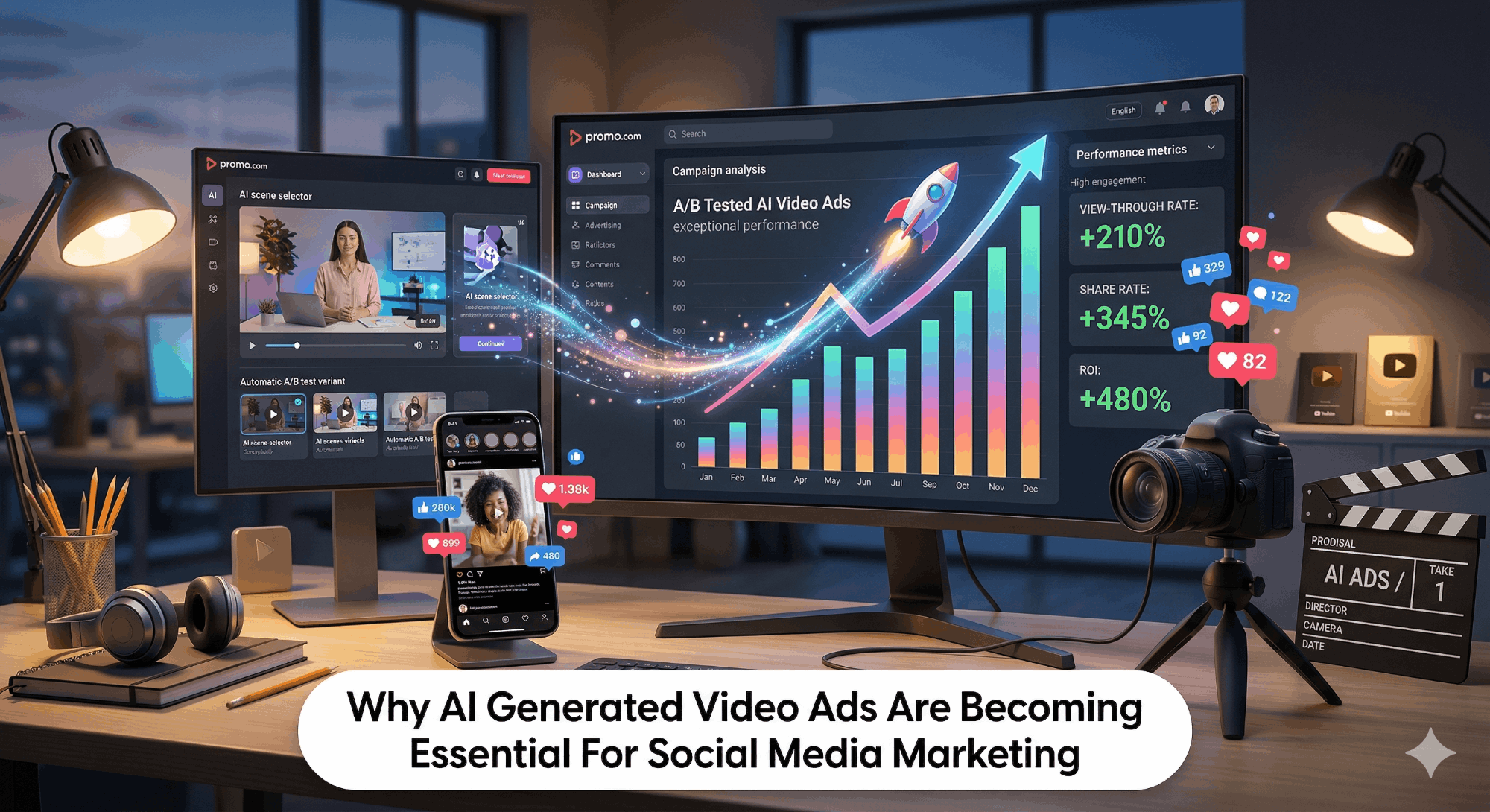
Why AI Generated Video Ads Are Becoming Essential For Social Media Marketing

Social media advertising has never been more competitive.
Audiences scroll faster, attention windows are shorter, and the volume of content competing for a single impression grows every quarter. For marketers, the pressure to produce video ads consistently, at high quality, and across multiple platforms has moved well beyond what traditional production workflows can support.
In response, artificial intelligence has moved from a promising experiment to a practical production tool.
According to the IAB Digital Video Ad Spend and Strategy Report, 86% of ad buyers are already using or planning to use generative AI to build video ad creative. That number reflects a fundamental shift in how marketing teams think about production, speed, and scale.
The question is no longer whether AI video advertising works. This is why it has become essential, and what specifically it delivers that traditional methods cannot.
Here is the full picture.
1. Social Platforms Now Reward Volume and Consistency
The way that algorithms determine the scope of your content’s reach on Instagram, TikTok, Facebook, and YouTube is by favoring accounts that regularly produce content that elicits engagement.
A brand that produces three strong video ads every week will reach more people than a brand that produces one amazing video ad every month. That’s not a creative statement. It is just how distribution happens.
This leads to a production issue that most marketing teams were never designed to handle.
If you’re producing three video ads every week, you’ll have to script, find images, edit, caption, resize, and schedule. That’s a full-time job in and of itself for a small team. For a larger team, that’s still a big portion of your resources.
AI-generated video ads fix this problem directly.
By automating the process of assembly, captioning, formatting, and resizing, AI enables a business to create multiple pieces of video ad content in the time it used to take to create one. The amount that the algorithms reward is now within the reach of the business without requiring them to increase the size of the team.
According to the HubSpot 2025 State of Marketing Report, the most successful content format that marketers are investing in is short-form video, and the businesses that are seeing the best return on investment are those that are producing it most frequently.
The algorithms reward new content. Content that was relevant last week is not rewarded in the way that new content is. This means that the problem of production is not simply a matter of cost. It is a matter of visibility.
A business that is not able to produce video content frequently is not visible in the feed of the target audience, regardless of the quality of the individual pieces of content. AI solves this problem by compressing the production time from what was previously a multi-day process into what is now a single-day process.
2. Short-Form Video Is Now the Dominant Paid Ad Format
Short-form video content has shifted from an emerging ad format to the dominant method for social media advertising.
Collectively, Instagram Reels, TikTok, YouTube Shorts, and Facebook Reels comprise the majority of social video ad impressions. These platforms are growing their investments in these ad surfaces.
According to the social media statistics research by Sprout Social, short-form video content under 60 seconds represents the format that consumers are most likely to engage with across all major social media platforms. Reels comprised more than half of all ads shared on Instagram in 2025.
Both the pace and vertical requirements are handled by AI video tools.
For AI video ads for Instagram and AI TikTok video ads, the use of native formatting is critical. Using a landscape video for a vertical feed format will tell the consumer quickly that the content was not created with them in mind. An AI advertising video creation platform with social media presets will format the content to the exact specifications required by each social media platform. The content will be seen as legitimate because it was created for the environment within which it is being presented.
The number of short-form ad placements continues to grow. Both Instagram and TikTok have announced new ad surfaces related to Reels and short-form video content over the past two years. YouTube has expanded the footprint of Shorts within its ad network. To be aware of the ad distribution means to be aware of short-form video.
The creative requirements for these ad formats necessitate a pace that only an AI advertising video creation platform can provide.

3. AI Enables Creative Testing at a Scale That Changes Campaign Performance
One of the most important reasons why automated social media video ads are becoming indispensable is the ability to test multiple creative variations simultaneously.
Testing two variations of an ad means making two ads. Testing five variations of an ad means making five ads. At such a cost and time implication, most businesses simply choose to run one ad and hope it works.
AI eliminates this limitation altogether.
An AI short video ads generator can make multiple variations of the same ad with different hooks, different calls-to-action, or different visual styles and voiceover tones in a matter of minutes. These variations can then be rolled out as a formal A/B test with a small budget, the best one determined based on real-world performance, and the budget scaled up for the best-performing ad.
This is how big advertisers have been operating for years. The barrier to entry had been too high for most small and medium-sized businesses.
Now, it’s no longer the case, thanks to AI.
A business that has a small paid social budget can now conduct the same level of creative testing that big businesses are doing, and make their spending decisions based on data and not instinct.
The effect on campaign performance is substantial. If a business is testing five creative options instead of one, they are collecting five times more data on what is working for their audience. Over time, they are building up that data to understand what is and isn’t working, and that informs not only their next campaign but their content strategy in general.
AI makes it possible to build that knowledge base in a short period, not over years and thousands of dollars in human experimentation.
4. Personalization at Scale Is Now Expected, Not Optional
Audiences on social platforms have been conditioned to expect content that feels relevant to them.
Generic advertising that speaks to no one specifically is tuned out faster than ever. Effective AI video marketing ads address this by making it practical to produce content tailored to different audience segments without multiplying production costs.
An AI video ad creator tools platform can generate versions of the same ad optimized for different demographics, locations, product interests, or stages of the purchase journey. A business selling a product to both new and returning customers can produce one version that speaks to discovery and another that speaks to loyalty, without commissioning two separate campaigns from a production team.
According to Statista Digital Video Advertising Market Data, global ad spending on short-form videos is projected to reach $115.75 billion in 2025 and grow at 13.68% annually through 2030. As audience expectations shift and platform targeting becomes more granular, the ability to produce personalized AI campaign video ads at scale moves from a competitive advantage to a baseline requirement for brands that want to maintain relevance.
5. The Cost and Speed Advantage Is Now Too Large to Ignore
Traditional video ad production involves a chain of steps, each with a cost: scripting, footage sourcing or filming, editing, captioning, audio mixing, resizing for platforms, and scheduling.
A professionally produced 30-second social ad can run from several hundred to several thousand dollars, depending on the production level. For a campaign requiring multiple creatives across multiple platforms, the cost compounds quickly.
AI consolidates most of those steps into a single automated workflow. The Zebracat data shows a 53% average reduction in production costs for businesses that have made the shift. Beyond cost, the speed advantage affects campaign agility. A business that can respond to a trending topic, a competitor move, or a seasonal moment with a finished video ad in hours rather than days has a meaningful operational edge.
For businesses using platforms like Promo, the pipeline from concept to published ad can run entirely within one tool.
PromoAI generates a complete branded video from a website URL, pulling product content automatically and assembling it into a finished clip. The platform includes over 275 million licensed photos and video clips through its Getty Images partnership, built-in social format presets, automatic captioning, and direct scheduling to social accounts.
The result is that AI advertising video tools like Promo reduce not just cost but the number of tools and handoff steps a team needs to manage.
In practice, this means a marketing team can go from a new product announcement to a published, platform-optimized video ad across Instagram, TikTok, and Facebook in a single working session. For teams managing content calendars across multiple channels, having creation, approval, and scheduling inside one platform removes the coordination overhead that slows most campaigns down.
6. Audiences Are Increasingly Watching Without Sound
One of the more consistent findings across social media research is that a significant percentage of video content is consumed while muted. People may scroll while out in public, or they may simply be used to scrolling with the sound off. In the context of video ads, this means that without any form of captioning, the ad is not visible to a significant percentage of the audience it reaches.
Video platforms that use AI solve this issue. They automatically create captions from the audio, syncing them with the time the audio is played and conforming to the brand’s style guidelines. In the case of AI social media advertising videos, this is not a “nice-to-have.” It is a requirement for the ad’s effectiveness, and the AI ensures that it is part of the process automatically.
Furthermore, captions also extend the reach of a video ad. Individuals who are hard of hearing or for whom the spoken word of the ad is a second language stand to benefit from the use of captions. Platforms are also beginning to use caption data as a signal for their content index, meaning a captioned ad stands to appear more places than an uncaptioned ad.
The point here is that the failure to caption a video ad is no longer a minor failing. It is a structural disadvantage. AI-powered production makes it easy to get it right every time, at no extra effort or expense over the uncaptioned version.
7. The Industry Has Already Made the Shift
Perhaps the most compelling reason that AI video ads have become an essential part of any business is that the competitive landscape has, in effect, changed.
A study done by the IAB in 2025 revealed that 86% of ad buyers are currently using, or have plans to use, generative AI for video ad creatives, and 85% are currently using it for social media ad creatives.
That is not a prediction. That is where the industry is currently at.
For a business that is still currently producing all of its social video ads in a manual fashion, it is not an ideal comparison. It is a comparison against a business that is currently producing more ad creatives, testing more ad creatives, and optimizing more ad creatives. The advantage that AI technology has in terms of production is cumulative. The longer a business waits to become familiar with the technology, the larger the gap becomes.
Early adoption, in this context, doesn’t mean using AI for everything and relying solely on it to guide your judgment. Early adoption, rather, means having the internal capability to use these tools effectively, so when the campaign needs to move quickly, or a new platform placement becomes available, the business isn’t starting from scratch.
The businesses that are best prepared for the next iteration of social media advertising are the same ones that are comfortable using AI-assisted production currently. Investing in the ability for your marketing team to use AI-assisted production, while the tools are readily available and the learning curve is low, is the most practical way a business or marketing team can invest in their future capabilities.
Tools like Promo offer a very accessible way to use AI-assisted production. With the ability to create videos, use licensed media, social format presets, auto-captioning, and publish to social platforms, the process of production becomes much more manageable for a business, even if they haven’t had a production team.
AI eliminates the friction of production for businesses that have traditionally viewed production as a hurdle.
Final Thoughts
AI generated video ads have become essential for social media marketing because the platforms demand volume, the formats demand precision, and the competition demands speed.
Traditional production workflows were not built to meet all three requirements simultaneously. AI is.
The technology is not a replacement for marketing strategy or creative direction. But it is a highly capable production partner that handles the repetitive, technical parts of video ad creation, freeing marketing teams to focus on the decisions that require judgment.
For businesses ready to close the production gap, tools like Promo AI are a credible and practical starting point.
The shift is already underway. The only variable is how quickly each business decides to be part of it.


