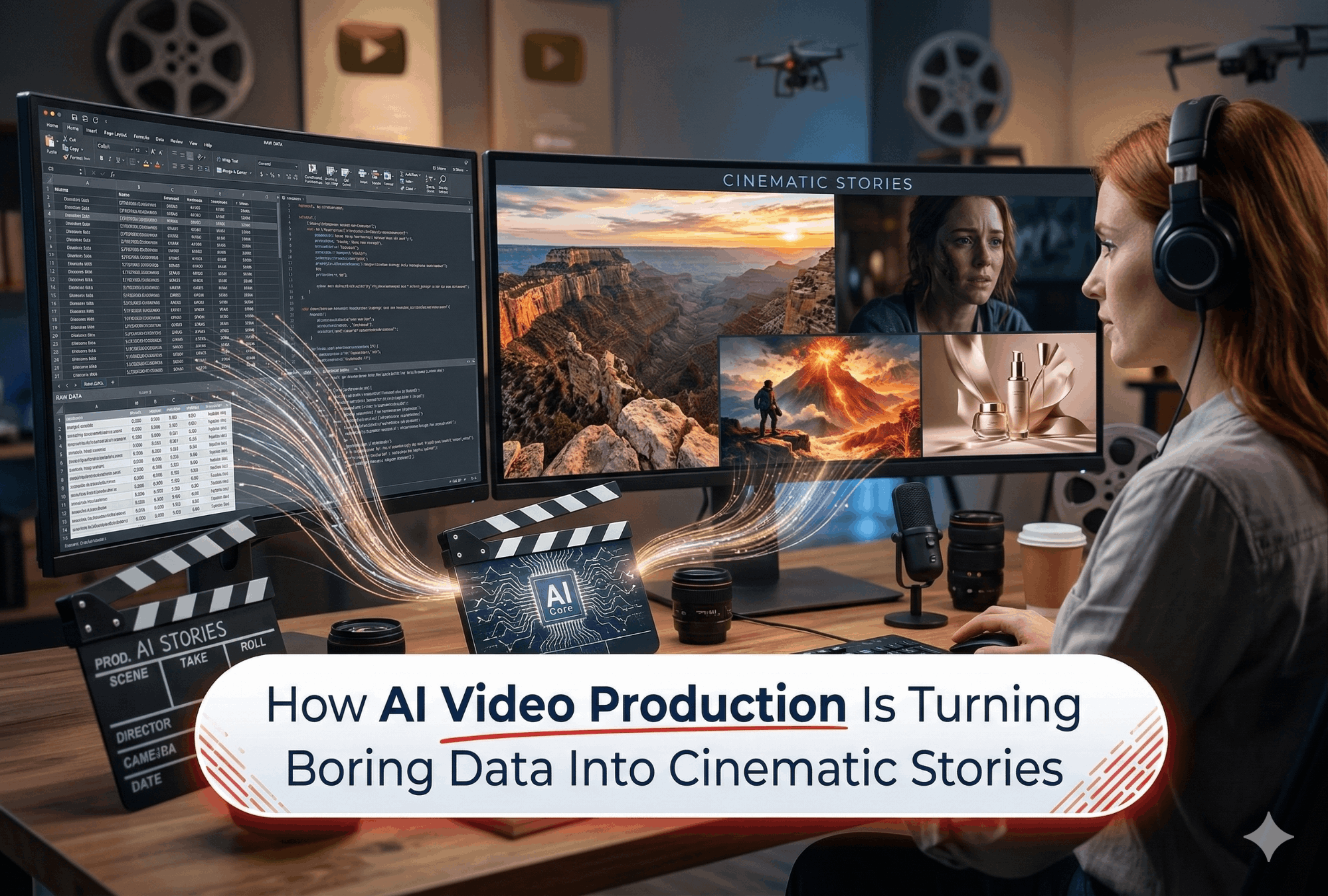
How AI Video Production Is Turning Boring Data Into Cinematic Stories

Marketers spend hours poring over a spreadsheet overflowing with sales figures, customer stats, and campaign results, only to struggle to communicate any of it in a way that actually sticks. Static charts scroll past, dense reports go unread; however, videos get watched.
A report shows that up to 82% of people have been convinced to buy a product or service by watching a video. For a long time, it has been a challenge to turn unprocessed data and dry information into content the masses want to consume in video form, and AI video production is changing exactly that.
This guide explores how AI video creation can repurpose boring data into cinematic tales and why you should embrace these advancements to create high-quality content.
Why Data Alone Doesn’t Tell a Story
Numbers tell you what happened, while stories show why it matters. That gap between raw data and meaningful narrative is where most content falls flat.
Think about a business trying to explain a 40% jump in customer retention. A bar chart conveys the information, but a short, well-paced video that walks through the journey, showing the problem, the turning point, and the outcome, makes people feel it. When someone sees a stat inside a story, they remember it. When they see it in a table, they forget it.
This is why data-rich content doesn’t perform. You’re asking the audience to do interpretive work they won’t do. They need a guide, a sequence, a point of view. Video content provides all three, and AI video production now makes this quite attainable without a whole production team.
Most companies have information in their organization that they can’t disseminate effectively. Monthly reports, product comparisons, customer success stories, survey results. All of this is valuable data, but almost none of it becomes engaging content because the production barrier is too great. Automated video production is what lowers the barrier.
How AI Video Production Happens
Automated video production involves more than fast footage assemblage. The top-of-the-line solution today examines both the structure and the content you provide: a script, talking points, product spec, or data set, before making editorial choices.
They decide which video or photo fits best, how to pace the cuts, where to place the text on-screen, and how to match the music to the feel of the message.
This is where machine learning video production becomes genuinely helpful. The AI models are trained on a massive number of successful videos, so they learn what helps a video maintain viewer attention and how to plot a video in under 60 seconds.
AI video automation also streamlines the technical work that slows down production, such as adjusting size for various platforms, resizing text for readability, and choosing resolution. These tasks used to add hours to a production timeline. With the right tools, they occur automatically.
Here are ways AI production can help turn complex data into cinematic stories:
1. Transform Complex Content into Video Formats

An AI-powered video maker is built specifically for businesses that need to produce video content at scale without compromising on quality. You supply the brand information, goals, and key message, instead of starting from a blank slate. The AI tools handle assembly.
AI video maker platforms such as Promo rely on technology that draws from a library of licensed videos and images to create a complete video tailored to your content needs. The platform automatically selects the right clips for your business type, uses your brand colors and fonts, adds music in line with your tone, and writes the captions/on-screen text.
What makes AI video automation especially useful for data-heavy content is that it works with structured input. It could be a product launch summary, campaign results, a video presentation, or a report highlight. Whatever it is, AI video creation tools capture what’s essential.
This entirely alters the production equation for businesses with regular social campaigns. What used to take a full day of work can now be handled efficiently in minutes, and because AI video production tools like Promo are trained on what performs, the output is built to hold attention.
2. Transform Numbers into Narratives through Storytelling
The most powerful way to use AI video storytelling is to turn cold figures into something human. An analyst who spends most of his time in dashboards finds a 22% increase in conversion rates meaningful. However, a customer or stakeholder who doesn’t live in the numbers requires context, and that context is best delivered in a story.
Intelligent video creation tools can structure data within a narrative framework, enhancing its impact. Rather than starting with a figure that lacks context, the video begins with a problem people face, depicts the change that occurs, and ends with the result.
Even when put into a 30-second segment, that three-part framework still gives that data a shape that’s easy to grasp and remember.
This is also why AI marketing video tools are now included in content processes. The ability to generate quick videos from a quarterly update, a product milestone, or a change in a customer success metric shifts who gets to tell that story.
Companies no longer require a commitment, but they benefit greatly from it. With a clear message and a suitable tool, any team can produce content that communicates it well.
Practical Uses: Where This Shows Up in Real Campaigns
AI-generated social media videos are the most visible use case today. Teams are now encouraged to consistently post across Instagram, TikTok, Facebook, and YouTube.
Each platform has its own set of expectations regarding format, optimal lengths, and audience behavior. Most cannot afford to create unique content for different platforms and channels.
Automated video editing lets you take a single piece of source content and reformat, trim, and restyle it for various platforms without having to start from scratch. Promo’s platform automatically adjusts aspect ratios, timing, and places text appropriately for each platform.
For product-focused brands, AI explainer video maker tools use product specifications and key selling points to create explainer videos that show customers what a product does and why they should care. No audio, animation, or editing is required.
Brands running paid campaigns can explore video ad templates from across industries and formats on Promo.
AI Video Editing: The Importance of the Details
The editing layer is probably the hardest stage to get right in AI video production. When do you cut? How do you choose a clip that has the right energy for the narration? How tight do you keep the pacing without rushing it?
AI video editing programs can now help with those decisions by looking at the content. They identify the best moments in the clip, cut out any dead air and pauses, sync any cuts to the music’s beat, and adjust the timing based on the final video’s length.
When it comes to AI content video tools like Promo, the editing layer is already integrated into the production process. You are not getting raw footage to cut. You are getting an edited video put together from your input, optimized for your platform.
What AI Video Production Means to Businesses without Video Teams
Traditional video production was built around one assumption: that you either had a production budget or someone on staff who knew how to use editing software. Most small and mid-sized businesses had neither.
Most marketing videos never met the required standards, and often detracted from the message they were trying to send. AI video creation eliminates that assumption. With the technical details, including codec settings, file formats, resolution, platform specs, etc., taken care of by the tool, you can now create winning videos concentrating purely on the message.
The threshold for quality has risen significantly; quality can no longer be bought with experience or budget. The ability to narrate stories using data has now shifted. An independent marketer from a small brand can now create content that visually rivals that of larger brands. The narrowing quality gap is thanks to easily accessible AI-powered video maker tools.
Using Templates for AI-Powered Video Production
When discussing AI video automation, no one really acknowledges the importance of templates. The output quality is as high as it is due to the templates. A good template follows a trusted structure. The pacing is streamlined, the visual hierarchy is established, and the format is confirmed through extensive actual use.
Promo’s template library offers businesses a working starting point. The AI layer applies your brand’s fonts, colors, and messaging, so it feels customized, even as the structure remains set. The blend of solid structure and intelligent personalization makes automated video production feel like it was created by a creative team, not put together by a machine.
Beginning with a template for the relevant message type (whether it’s a product launch, a campaign result, or a customer story) ensures that, for data-driven content, the narrative structure is in place. You provide the details, and the tool does the rest.
What to Expect as AI Video Production Tools Keep Developing
AI video creation tools are beginning to understand nuance, including tone, brand voice, and audience. Outputs are becoming increasingly accurate and easier to create. What takes a few review loops today will likely take only one or two as these machines improve.
However, it works best for use cases that benefit from consistency and speed, such as social media highlights, product videos, campaign recaps, and AI explainer videos with statistics. It is also effective for storytelling formats with an emotional arc, especially when the content does not require perfect execution on the first attempt.
But even in this category, specific tools handle more of the execution than they did a year ago. In all scenarios, though, it’s obvious you need fewer people involved.
The companies that benefit the most from this right now are those using AI video production to remove friction between having an idea and putting it in front of the people. It used to take time, money, and technical skill, but now takes almost none of those things, thanks to AI video tools.
Ultimately, you still need to understand the basics of video marketing, right up until the point that AI is doing the actual production work. The audience, strategy, and message all come from you. What AI removes is the gap between having a good idea and executing it properly.
Start Turning Your Boring Data into Cinematic Stories Today
Data is only helpful if people can understand it, and people understand stories far better than they understand spreadsheets. AI video production is now the most effective way to bridge that gap by turning reports, stats, and product info into content that people watch and remember.
Promo provides an extensive template library and AI video creation tools built for precisely this kind of work. You don’t need a production budget or a creative team to get started with video marketing. All you need is data and the right AI video maker tool to create the magic.
FAQs
- What does AI video production mean?
AI video production is a process in which different Artificial Intelligence tools are used to automate video production, including selecting footage, editing clips, writing captions, and adjusting pacing, helping produce videos faster with less manual effort.
- How does Promo’s AI-driven video maker function?
Promo AI gathers your brand information, messaging, and objectives, then selects footage on autopilot, brands it with your style, adds music, and creates a full video. Companies without a dedicated content team can benefit from Promo AI’s video production capabilities.
- Can AI video tools handle different social media formats?
Yes. Some tools automatically resize your video for Instagram, TikTok, YouTube, and Facebook. So, you wouldn’t need to re-edit for every channel.
- Is AI video creation suitable for heavy data content?
Sure. AI video storytelling tools can take structured data such as stats, results, and product specs and construct a narrative around it to ensure the data is easy to comprehend and engaging for the audience.
- Is prior experience in video editing necessary for using an AI video generator?
No. Most AI video maker platforms are created for people with no editing backgrounds. The AI makes technical decisions so you can focus on the message and purpose.


