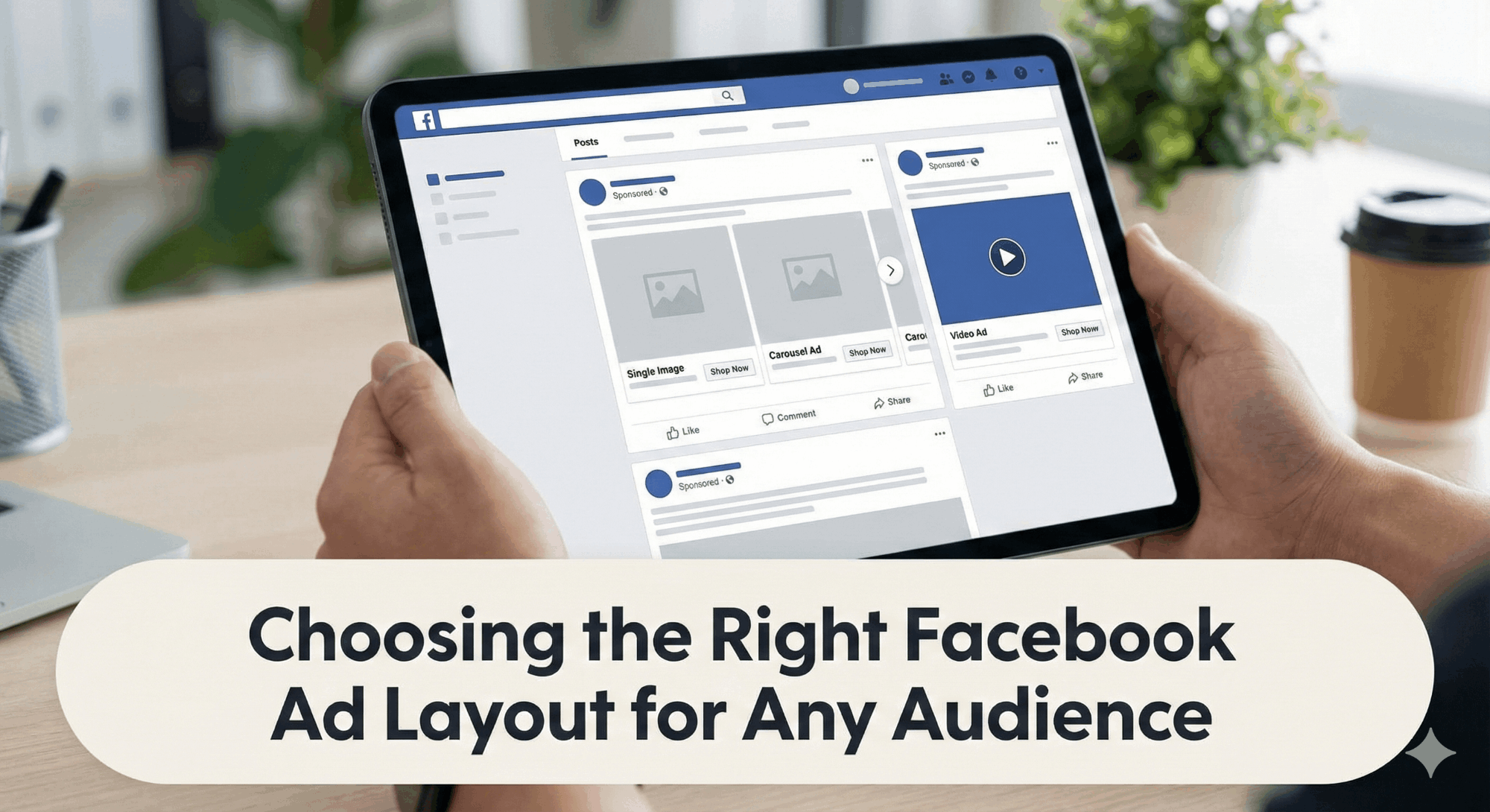
Choosing the Right Facebook Ad Layout for Any Audience

Ad layout is one of the critical elements that rookie marketers often skimp on. But unknown to many, its impact can be far-reaching.
A proper advertisement layout captures your audience’s attention and gently guides them into the lead funnel. It also boosts engagement, increasing the average view time.
Ultimately, a professionally rendered ad layout can yield substantial returns on ad spend (ROAS). It’s precisely what you need to wage a successful social media marketing campaign on platforms like Facebook.
However, determining the right Facebook ad layout can be a monumental challenge for inexperienced digital marketers.
On the one hand, you want a layout that captivates your audience’s interest. Yet, on the other hand, the design should align with your marketing goals.
You’d also be keen to choose an uncluttered Facebook advertisement layout. This helps sift out all the noise, getting the message to your community with minimal distractions.
But if you’re new to Facebook advertisement, you’re probably wondering – which layout style suits your Facebook ad best?
Read below as we help put that question in perspective.
What Is An Ad Layout?
An ad layout refers to the physical arrangement of the key visual elements within an advertisement.
The term is commonly applied with respect to image and video commercials. But it applies to all promotions, including text-based advertisements.
Critical ad layout elements include headlines, texts, keywords, slogans, images, and sound effects. All these components must achieve visual harmony for a commercial to deliver the intended impact.
A Facebook video layout determines how users interact with the content. By rendering the visual elements more attractively in the illustration, you can effectively convey the intended message and capture the audience’s attention.
Can your Facebook ad be a video?
While Facebook is famous for text-only chatting, studies have shown that most consumers prefer video-based ads. So, not only does Facebook support video advertisements. Running video promotions may yield a higher return on ad spend than plain text advertisements.
Fortunately, you don’t need to generate Facebook video ads from scratch. Not when you can automate the process with tools like Promo.
Promo lets you make professional videos for social media advertisements. The platform is powered by artificial intelligence (AI), streamlining the video generation process.
Besides, AI integration makes Promo an excellent pick when designing proper layouts for your Facebook ads.
The Role of Visual Harmony in Designing Ad Layouts
An ad layout’s core elements must be visually balanced. Each component should be equidistant from the reference point, which is the advertisement’s optical center.
Avoid layouts where most of the elements are aligned towards specific margins.
It’s also best to ensure all components have equal weights. While you can highlight certain phrases, maintain proportional font sizes throughout the content.
Needless to mention, the best Facebook ad formats should emphasize readability. Legible elements enable readers to grasp the message instantly.
Other key ways to achieve visual harmony include;
- Using a consistent font style
- Using relevant imagery
- Maintaining a uniform color scheme
- Strategically use white space between elements
- Repeating shapes and motifs throughout the advert
- Overlapping visual elements
- Holding all elements together using a border
Why Does Ad Layout Matter?
You can gauge the impact of any social media advertisement by its ability to capture your audience’s interest.
A professionally designed ad template should be visually appealing. The design should arrest the attention of any casual viewer, encouraging them to engage with the content further.
A well-executed ad layout also lets you convey your messaging instantly. By strategically placing patterns that social media users mostly identify with, you can pique their attention and maximize the ad’s reach.
Other benefits of a good Facebook ad layout include;
1. Improving User Experience (UI)
Besides visual appeal, Facebook layouts should be non-intrusive. This minimizes bounce rates and improves the overall user experience.
2. Multi-device Adaptability
The right Facebook ad layout should be adaptable for different screen sizes. It lets you target individuals using social media via different devices, including mobile phones.
3. Maximizing Audience Reach
Social media audiences vary by age, geography, psychology, and purchase behavior. The right ad layout should appeal to the intended audience.
As hinted, creating high-converting ad layouts can be a monumental challenge for first-time social media marketers. But that’s where automated tools like Promo come in.
AI-powered ad generators are incredibly time-saving. Besides, these tools can help you whip up a compelling promotion by recommending a layout that suits your target demographics and marketing goals.
Some AI ad generators offer video editing, too. Even after creating Facebook commercials, you can unlock advanced editing features to fine-tune the content as desired.
Perhaps the next question you’d need to settle is – what size is a Facebook ad template?
We explore that question in the next section by highlighting the ideal Facebook aspect ratios. As you shall find, those dimensions vary depending on the audience and content type.

Factors to Consider When Choosing the Right Facebook Ad Layout for Different Audiences
Layout Tips for All Audiences
1. Stick to Vertical Layouts
Vertical and square layouts tend to fill up screen space. They’re notably effective at displaying your Facebook advertisements on mobile devices, helping ramp up user engagement.
Square layouts are also more scrollable. Therefore, you can trust them to pop up on your Facebook community feeds without being too intrusive.
Note that most social media users prefer non-intrusive ads. A vertical video layout lets you run your promotions in the background, giving your followers an option to choose whether to click on the commercial or not.
2. Prioritize Mobile-optimized Layouts
Facebook is the most used social networking platform globally. As of 2025, the website reported some 3.07 billion active users monthly.
Studies further suggest that 96% of Facebook users access the website via mobile devices. That underscores the significance of creating mobile-optimized ad layouts.
As noted, square and vertical designs perform best on mobile devices.
Layout Tips for Different Ages
1. Younger Demographics
Prioritize bold, colorful designs if you’re creating Facebook ad layouts for younger demographics. Multiple surveys have shown that Gen Zs and millennials prefer interactive content.
However, maintain simple and interactive layouts. Cluttering your ads with unnecessary embellishments will be counterproductive.
Younger audiences also respond better to dynamic content. Instead of plain product descriptions, opt for social media reels.
Reels are not only engaging. They’re also shareable, potentially extending your ad’s reach.
Stories may also deliver greater impact with Gen Zs. Whether it’s a brand narrative or a consumer product hunt, a compelling story can spark engagement better than traditional videos.
Besides, it’s comparatively easier to create a balanced ad layout with stories than regular promotional videos. That’s because you’d focus more on the narrative and accompanying images, only highlighting other visual elements like logos at strategic points.
2. Older Demographics
Mature audiences relate better to professional layouts. Minimize casual elements like emoticons, opting for traditional images instead.
Consider a Facebook carousel layout while designing social media ads for older demographics. Besides their visual appeal, carousels also perform exceptionally well on desktop.
The font choice can also make or break your Facebook ad layout.
If mature audiences are the primary target, opt for professional typefaces like Calibri and Verdana. Minimize fancy fonts or avoid them altogether.
Be sure to also choose larger font points. After all, your target audience likely comprises individuals with failing vision.
However, stick to typefaces that align with your company. It enables your community to instantly recognize your brand.
Like younger demographics, mature audiences prefer simple ads. You can avoid clutter by creating a Facebook single image layout.
Besides, arrange your visual elements hierarchically. Clear hierarchies help guide viewers’ eyes through the ad, leading them to your CTAs.
Use colors, size, and weights to achieve a hierarchical design.
However, minimize visual dynamism. Have one central image on which you build the storyline.
Don’t forget white spaces.
Executing empty areas between elements provides a breathing space, preventing the ad from becoming visually overwhelming. It also improves viewer focus and readability.
Choosing Proper Layout Sizes
1. Full-screen Layouts
A full-screen Facebook ad layout displays your commercials on the entire screen.
While this design minimizes competition, you must make it count. The layout is best for elaborate product descriptions.
You may also consider full-screen layouts when creating ads with a sense of urgency. Examples include limited-time offers, unexpected price changes, and change-of-location pressers.
Despite being attention-grabbing, full-screen layouts may come across as too intrusive. Especially avoid them when targeting mature audiences.
2. Split-screen Layouts
Split-screen layouts feature two or more sections of the same ad.
This design technique enables you to showcase your offerings from different perspectives, making it great for 360-degree product descriptions.
Many AI video generator tools let you try out different split-screen layout styles.
For instance, you can choose to split the screen vertically or horizontally. Define your intended goals, then pick a size that works best for you.
Choosing Proper Aspect Ratios
A video’s aspect ratio denotes the proportional relationship between its width and length. It’s what ultimately determines whether a Facebook ad layout is portrait, landscape, or square.
One exciting thing about aspect ratios is that you can experiment with pretty much any orientation. However, it’s best to understand the most impactful ad layout proportions.
Choosing a proper aspect ratio is particularly important if you’re planning on running your commercials on social networking platforms like Facebook. It lets you balance between creating a captivating, yet non-intrusive ad.
Widescreen (16:9) is one of the most common Facebook video aspect ratios.
A widescreen aspect ratio covers the entire screen. Consider this proportion if you want to create an immersive viewer experience, such as elaborating on how your products work.
Widescreen aspect ratios also deliver a professional feel. They display your ads more realistically, making them particularly great for mature audiences.
However, a widescreen only works with horizontal content. It’s also effective for displaying your Facebook ads on screens with a larger width than height, such as desktops.
Vertical (9:16) aspect ratio also delivers an immersive full-screen viewer experience. It’s best for highlighting short-form content, such as reels.
Square (1:1) is another Facebook aspect ratio you can use to create audience-targeted ad designs. This layout streamlines content rotation, making it great for mobile-first audiences.
Lastly, there’s portrait (4:5). This aspect ratio uses significant screen space but without blocking off the entire screen, making it less intrusive than full-length designs.
Layout Tips for Different Cultures and Geographies
Using location-specific imagery is one of the most impactful Facebook ad design tips. Incorporating the iconic Statue of Liberty or the Eiffel Tower into an ad leaves little doubt as to your primary target audience.
Since design layout is the primary concern, centralize the location-specific imagery and then build around it.
A single image will suffice. Unless you’re doing a ‘things to see’ advertisement, avoid stuffing your video with geographical landmarks.
Consider using local languages too.
Integrate subtitles harmoniously within your design layout to extend the ad’s reach. Make the subtitles readable, using legible font styles and points.
Besides, sync the wordings with the audio.
Align the subtitles towards the screen’s center bottom. This enables your foreign-language viewers to read the wording while keeping up with the visuals.
Moreover, have no more than two lines of subtitles popping up on the screen at the same time.
Layout Tips Based On Consumer Behaviors
Are you targeting a potential lead, first-time customer, or repeat client?
The answer will determine how best to design your Facebook ads. Use stunning visuals if you’re targeting potential leads or first-time clients.
Bold, colorful, and centrally aligned graphics will be sure to pique your followers’ interest. Integrate these attention-grabbing elements at the beginning of the video, gradually transitioning into the narrative as the clip plays on.
Repetition also works best for lead generation ads. Have certain graphics repeating consistently throughout the video, creating a rhythm with the viewer’s eyes.
Maximizing Audience Engagement With Captivating Ad Layout
Facebook demographics vary significantly. And so should ad layouts.
Before choosing the right layout for your Facebook advertisements, define your ideal audience.
Is the promotion targeted at the young and impressionable? Or, are you seeking to appeal to elderly folks who are set in their ways?
To refine your Facebook ad creative strategy, categorize your target demographics by real-time and historical behaviors. Advertisement layouts that appeal to potential leads are quite distinct from those used in retargeting promotions.
Remember to also prioritize the general messaging itself while designing a Facebook ad layout. Whether you’re creating a product description, press release, or brand story, you’ll do well to choose a layout that aligns with each content type.


